The boss wasn’t happy. In fact, he was really irritated. He liked predictability and no surprises, almost to the point of considering “boring” an organizational value. My boss expressed his dissatisfaction with a glitch in our major initiative with practiced self-control, asking strained questions of “why” and “how” with restrained tension in his voice that made you wonder if that was how ulcers got their start. My response of “We will get this fixed . . . now” was communicated with a practiced restraint that conveyed certainty and urgency without engaging in the urge to panic. After all, I’ve been practicing resolutions to issues since I was 16 years old and my father handed me a post-hole digger.
The beauty and social necessity of a field with straight plowed furrows cannot be overestimated. Every time I drove our farm pickup along the gravel roads, I would observe the plowed fields, as my father always did. Farmers judge each other’s ability as farmers in many ways, and the straight, symmetrical, plowed furrows in a field show that a farmer is top-notch, with bonus points when a hill, dip, or slight drainage crease complicates a field. Driving past a well-plowed field is almost hypnotic, watching what seem to be identical plowed rows pass by in quick succession. Beauty and poetry in motion. Missing even a small spot, largely unseen, and correcting back to straight plowing only postpones the societal mistake until weeds pop up in the unplowed flaw. If you have to spend countless hours riding a tractor pulling plowing equipment, you might as well make a perfect agricultural art display in the process. Fields that are not perfectly straight, especially when they have a curve or wave resembling art in a Dr. Seuss book, elicit knowing smirks among farmers talking at the International Harvester parts counter, maybe even questions about whether the farmer had a discreet hip flask and not-so-discreet tractor driving. The John Deere parts counter offered coffee, inspiring lingering with more farm conversations and talk of odd fields.
By the time I was 16 years old, I had already spent many hours on a variety of tractors plowing fields that took a few hours to most of a day. But today I would be farming adjacent pastureland with obstacles involved. Barbed-wire fences. As I climbed into the tractor and started up, Dad sat in the corner of the field supervising. It always made me nervous and mortified when he would step out of the pickup and into the dust from the plowing, waving his arms to stop for some type of “constructive criticism” and correction. Today, he warned me about the barbed-wire fence along the field and pasture line, casually telling me not to get too close with the equipment.
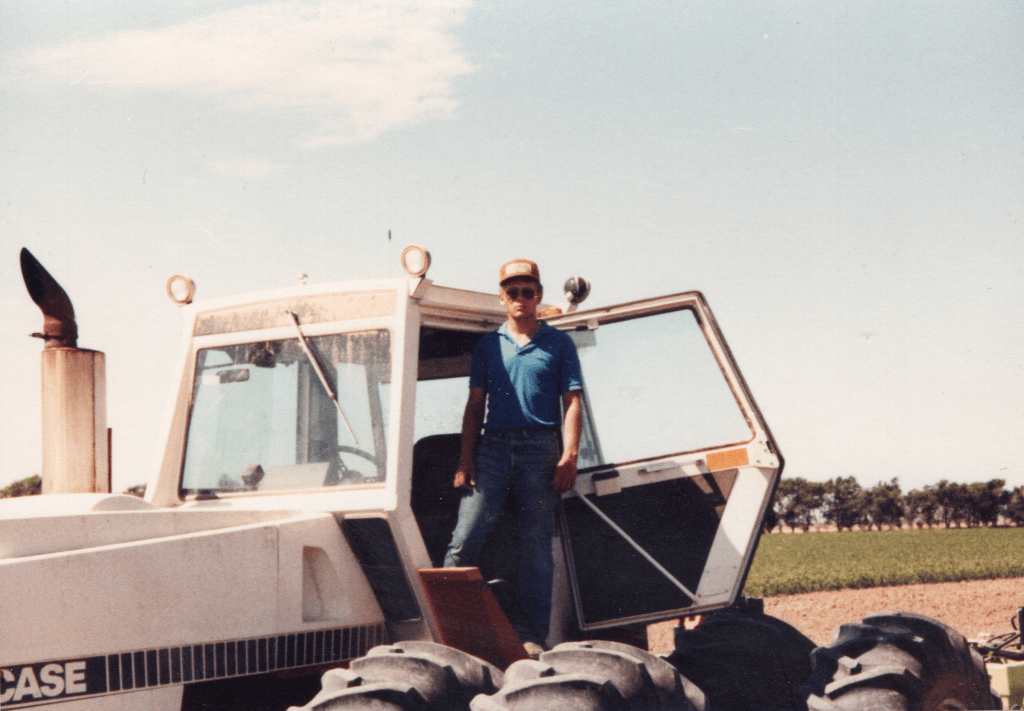
As I plowed the field, the cab of the Case 4890 tractor I drove stood seven feet above the ground on eight large tires, two tires per wheel. The equipment being pulled was 40 feet wide, with steel concave disks designed to cut into the soil and turn it over, helping to introduce air and churn stubble from the previous year into the soil. Depending on the season, there was little dust or so much that seeing the end of the equipment was difficult. On a good day, the gentle rocking of driving over the field, the warm sun coming into the mostly glass cabin, and the slow growling sound of the engine could lull you to drowsiness . . . and crooked furrows. Luckily, I wasn’t drowsy, but in trying to fully till the field, as close to the pasture as I could, I did it. I could not hear the damage, but I could see a fence post jump up as if its toes had been stepped on, followed by another post jumping and falling. I stopped the tractor to avoid catching barbed wire in the equipment. I noticed Dad’s pickup start driving toward my location.
Rolling up to the tractor but in front of the equipment gave the clear message that I would not be proceeding. As I climbed down the stair-step ladder built into the tractor between its large wheels, Dad slowly stepped out of the pickup and walked to the back of the pickup bed, where he began rummaging. Walking up to him, I watched as he propped two five-inch-wide fence posts against the side of the pickup. With both arms, Dad lifted the post-hole digger from the pickup, shifting it over to my hands. Surveying the fallen posts, he commented, “Well, you better get started replacing them. We don’t have all day. To stay on schedule, this field needs to be done today.” With a slight smile and a distant gaze, maybe remembering his own experiences, he commented, “You’ll only need to replace a few before never repeating it again.” As he drove away, I stood there holding a post-hole digger and noticing the heat of the midday sun.
A post-hole digger seems like a useful and efficient tool, but I have noticed several design flaws. It comes as one tool, but appears to me to be two spade-blade shovels with long handles, connected near the blades to make a single tool that spreads at the handles. It’s slyly two shovels for one person. Also, while many tools have motors attached for power and speed, a post-hole digger to this day relies on me as a human motor. As a pro tip, it’s a good idea to sharpen the spades with a file from time to time to make it easier to dig through pasture grass. Each time I raised and thrust the digger downward to grab and remove new soil, a deeper hole began to form from my slow work. Taking pauses to catch my breath only reminded me that the warm sun was becoming warmer. Knowing that my day ended when the field was plowed quickened my efforts. I had no interest in trying to plow straight furrows at night by floodlights and shifting dust. First post in place and tamped firmly, second one to go.
Climbing back into the tractor seat, starting the engine, and lurching back into motion felt like leaping into fast forward. Quickly correcting the tractor to avoid hitting yet another fence post, I guided the tractor and equipment to stay a close but respectful distance, not from the pasture’s edge but from the fence posts. During the next round I took of the field, I slightly overlapped my work to correct and straighten the visual scar to the once-straight furrows. A few rounds of plowing and all was right with my work, and the straight, perfect rows erased my mistake but not the lesson.
“We will get this fixed. . .now.” The Executive Director curtly responded, “You’ve got work to do.” The afternoon was late, but I jumped to work. My fingers flew on a keyboard as I stared at a glowing screen. I lost myself in correcting files, reviewing them for mistakes, checking for things missed, tying up loose ends. Time went by as I worked into the night doing what was necessary and making sure it was perfect and would pass scrutiny. At 2:30am I leaned back in the chair, noticing my stiff back.
The work was done.
I was good on my word.
I would pay for the late night later that morning. How many times over the years have I burned late-night oil for fixes that aren’t remembered two months later? I went home wondering if I could find a miniature pair of post hole diggers to lean in the corner of my work cubicle.


Leave a Reply