Once, when I returned with my young son to the high plains of eastern Colorado and the place where I was born and raised, he asked, “Dad, where are we?”
“The middle of nowhere,” I replied. Then, with a wry smile, “In fact, north of nowhere.”
As a kid, nowhere seemed about right. Farmsteads were scattered miles apart. But there was a jail within walking distance.
By then, the jail was nothing more than a concrete foundation in a wheat field, all that remained of the first version of Shaw, Colorado. I might never have known what it was had it not been on our land, where my father warned me to avoid it while plowing.
Walking along the foundation as a kid, I noticed that the ever-present breeze, often a brisk wind, was missing. A slight rise to the north obscured the otherwise flat, open country and its unobstructed horizon. Tucked at the base of the rise, the foundation seemed sheltered, protected. The grass around it was especially thick and tall, like an oasis amid the surrounding pastures of short, dry, sparse buffalo grass.
The old Shaw had a water problem, but not from a lack of it. About every four or five years, an especially strong thunderstorm dumped more rain than the chronically thirsty Arikaree could handle. Normally, when I explored sections of the thirty-foot-wide channel, I walked through sparse patches of grass attempting to reclaim the riverbed as prairie. But during the big storms, I marveled at how the riverbed could barely contain the rushing surge of water racing down its straight sections and hitting the bends with force.
Once, for entertainment, my father took my brother and me in the farm pickup to inspect the aftermath of one heavy storm. A small lake had formed at the site of the original Shaw, hiding the jail’s foundation beneath water instead of grass. My father, brother, and I sat in the pickup, too wary to get out and especially wary of driving farther across the small, old country bridge, with swift water nearly reaching its top. There were no birds chirping, no insects making sounds, just the sound of water seeming to complain that the bridge was in its way. I wondered whether the town had ever taken cover from a similar storm, only to be surprised by the flooding. I hoped there hadn’t been a poor cowboy stuck inside the jail, sleeping off a good time the night before, unaware that a free bath was included.
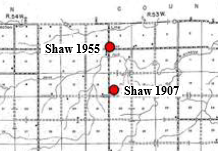
We watched the lake, the flooding, and the river from a nearby gravel road that stretched far to the north and twenty-two miles to the south, where the next town stood, with nothing in between but Shaw. To go home, we followed the gravel road north for half a mile and turned east at the crossroads. It was the same crossroads where Shaw had relocated.
When I asked the “old-timers” in their eighties about Shaw, none really remembered when it was founded. It had always simply been there. Other towns in the area, including ghost towns, stood along major roads rather than the lonely crossroads that Shaw called home. Shaw was located near the route of the old cattle trails running north from the travel hub of Limon to the southwest toward Last Chance in the north, across wide open pastureland with nothing else available for miles around. With a mercantile, mail, and a place to gather, I have often wondered whether cowboys stopped for supplies during the last years of the great cattle drives. When the cattle drives came to a close in the early 1900s as new railroads crossed the area, homesteaders began making farms out of what had long been cattle country. Shaw appeared during this transition, a little settlement at a crossroads serving the families putting down roots on the prairie.
The crossroads offered an almost 360-degree view of the flat prairie, stretching from east to west, with the land gently sloping downward toward the southern horizon. The only features breaking the horizon were sparse rows of trees serving as windbreaks around the few farms scattered across the area. The closest farm to Shaw was ours, where my family had settled in the mid-1940s.
Although my aunt had left the area many decades earlier, she clearly remembered Shaw’s community building and post office, especially the latter. The post office had a lone gas pump out front and housed the only mercantile for at least twenty miles in any direction, along with living quarters for Charles Shaw and his wife, Elizabeth.
The community building, across from the post office in the southwest corner of the crossroad, hosted dances and card games on weekends, often with a live band, and church services on Sundays. It was left unlocked in case anyone was caught away from home after dark or during a storm.
As a young girl, my aunt remembered the tiny, open post office boxes for about fifty addressees in a room no larger than five by ten feet. The postal counter often sold small treats for a penny or nickel. The post office and adjoining mercantile bustled with people gathering, gossiping, and conducting business in a community of farm families with no other nearby gathering place.
Ralph Sieberg lived on the road south of Shaw’s crossroads. He was one of those “bachelor farmers” whom nobody recalled ever having a wife. He wore a stubbly beard that never seemed to grow or be shaved clean, faded blue coveralls, and a large-brimmed trucker cap that sat level and firmly on his head.
He lived in a small, white, one-story house on the southern edge of Shaw, just before the land began to slope gently downward. Sometimes I saw Ralph sitting on his tiny covered front porch, his house just off the road, but more often I saw him driving along in his hard-used 1960s pickup.
Ralph often came by the farm to talk with my father and borrow tools, usually branding irons for marking his cattle. After a very long time, but before the tools were adopted as his own, we would drive over to retrieve them.
Ralph was large and kind, but he shrank to a timid boy whenever he encountered most women, including my mother, who was small and weighed less than a hundred pounds.
The Mason family lived on the western road in a one-story white house built in the old territorial style of a square structure with tall and thin windows and a low shingle roof peaked in the center. It seemed barely large enough to hold a mother, father, and two daughters. They farmed the land behind their house and around the northwest corner of the crossroads, where most of Shaw had once stood.
The house was on the same north side of the road as the post office and was considered part of Shaw, although it stood several hundred feet away. It raised the question of whether the house might try to break away from town altogether during one of the area’s frequent blustery days.
The family was pleasant and conversational, but generally preferred to keep to themselves.
Harv and Iva lived just a mile north of Shaw, but it seemed farther because the north road did not run straight past their house.
Shaw was only about half a mile south of the Lincoln–Washington county line. Although the builders of the road in each county could easily see the other’s work across miles of flat prairie, neither apparently would budge on its course. They stopped at the county line with their roads a quarter mile apart. The solution was a short connecting road called a “correction line.”
Harv and Iva’s house was a tiny, two-story place just off the north road where it resumed beyond the correction line.
Harv and Iva were known as homesteaders from an earlier generation and were decidedly “old school.” As a kid, I was amazed that their house had no indoor bathroom, only an outhouse behind it.
Once, Iva handed me a drink of cool well water she had drawn from a cast-iron hand pump in her kitchen. I also learned that the metal bathing tub, set in the middle of the floor and filled with hot water, was real, just like in the Western movies. That was how they took baths.
Iva was a kind, grandmotherly woman who loved to spoil children like me with freshly made cookies and always wanted whoever visited to stay for supper.
Harv, although a diminutive five feet two inches tall and as thin as a rail, commanded attention and respect with his no-nonsense demeanor and deep, gravelly voice roughened by decades of smoking cigarettes. His hands were worn and strong from years of homesteading and building a farm from nothing. To this day, when hear a reference to the rugged men who settled the land, I think of Harv.
They kept an underground root cellar and tornado shelter close to the house, and a wooden barrel outside filled with fresh well water. A weathered iron ladle was there for dipping a drink of cold, slightly mineral-tasting water.
As I grew up, the Masons moved away after their daughters graduated from school. Ralph left to be closer to family, and Harv and Iva, after a lifetime of long winters and hard work, earned a rest closer to theirs.
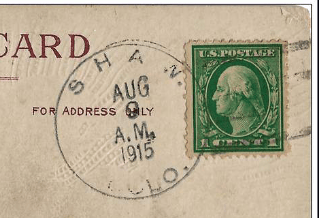
My memories of Shaw were only echoes of what once was. Postal records show Shaw’s death on Nov 30, 1955 when the post office closed, long before I was born. The Shaw I knew was little more than a corner lot where a town had once stood. Years ago, I took a photograph of Shaw with its remains of a small adobe storage shed, a rusted grain bin that hadn’t held wheat in decades, several stone foundations, and an old wooden barrel swallowed by the tall grass.
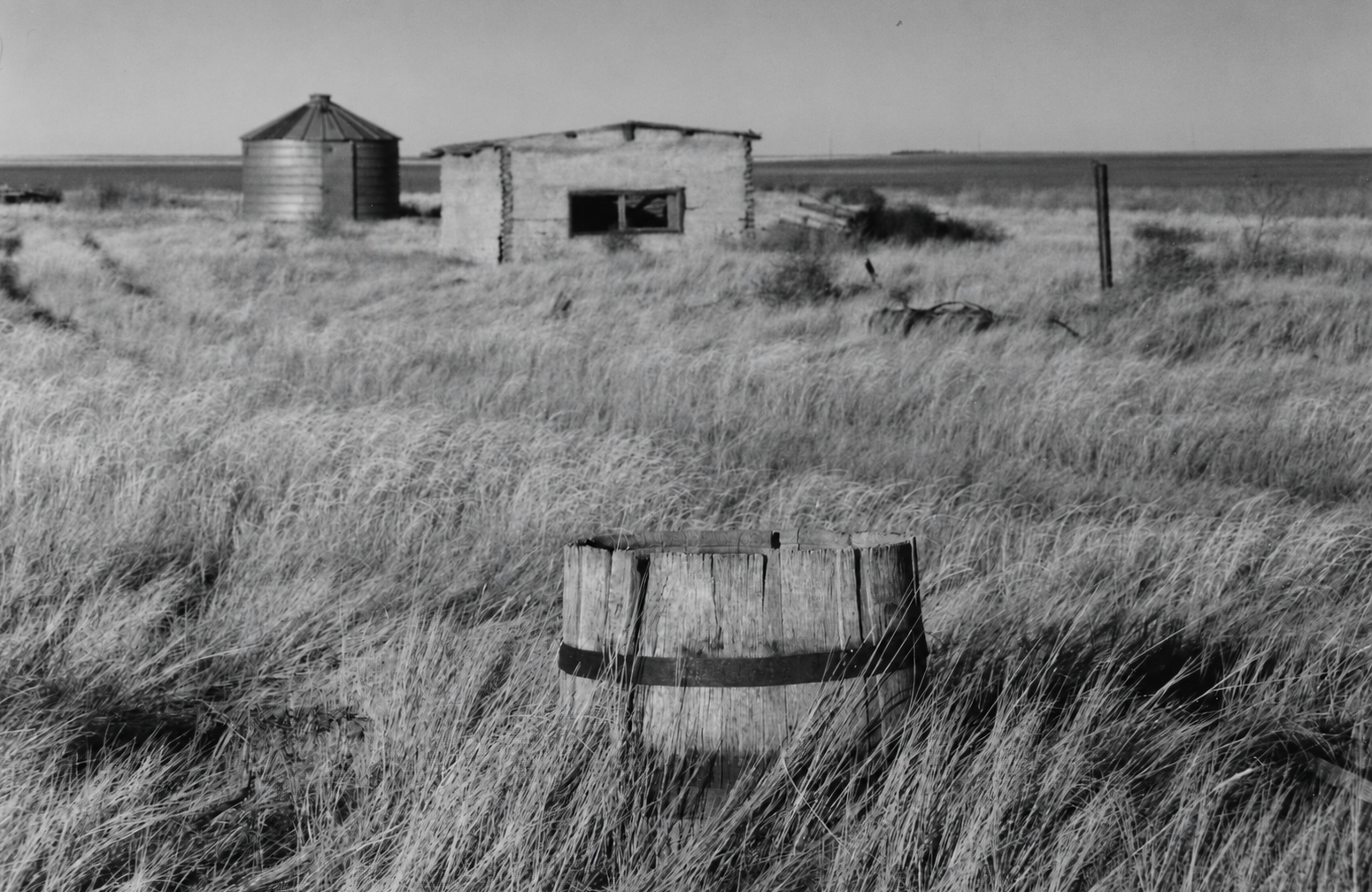
There were no sounds of dances, live music, or gossip from the post office. There was only silence, with the sense of feeling utterly alone that such a large and empty expanse can create, interrupted now and then by the slow calls of mourning doves.
Eventually, my family left the farmhouse, and Shaw, for a town far to the south, but continued to farm the surrounding land. The land, and Shaw, were left alone as the last signs of the town were gradually erased.
Whenever I return to the old farmhouse, walk the pastures we once owned, or follow the creek looking for arrowheads, I stop at the crossroads.
There is little left to mark Shaw. The post office is gone, the community building is gone, and the people I knew have long since moved away. The few remnants I once photographed are gone, too. Yet I can still place their houses along the roads. I remember Ralph’s pickup, the Masons’ old house, and the turn north toward Harv and Iva’s.
I sometimes wonder how many people are left who remember even the last traces of the town. I never knew Shaw as it once was, but I knew the last of it. I feel drawn to it, like the last resident, not quite ready to say goodbye.
The crossroads remain, and when I stand there, Shaw is there, too.


Leave a Reply