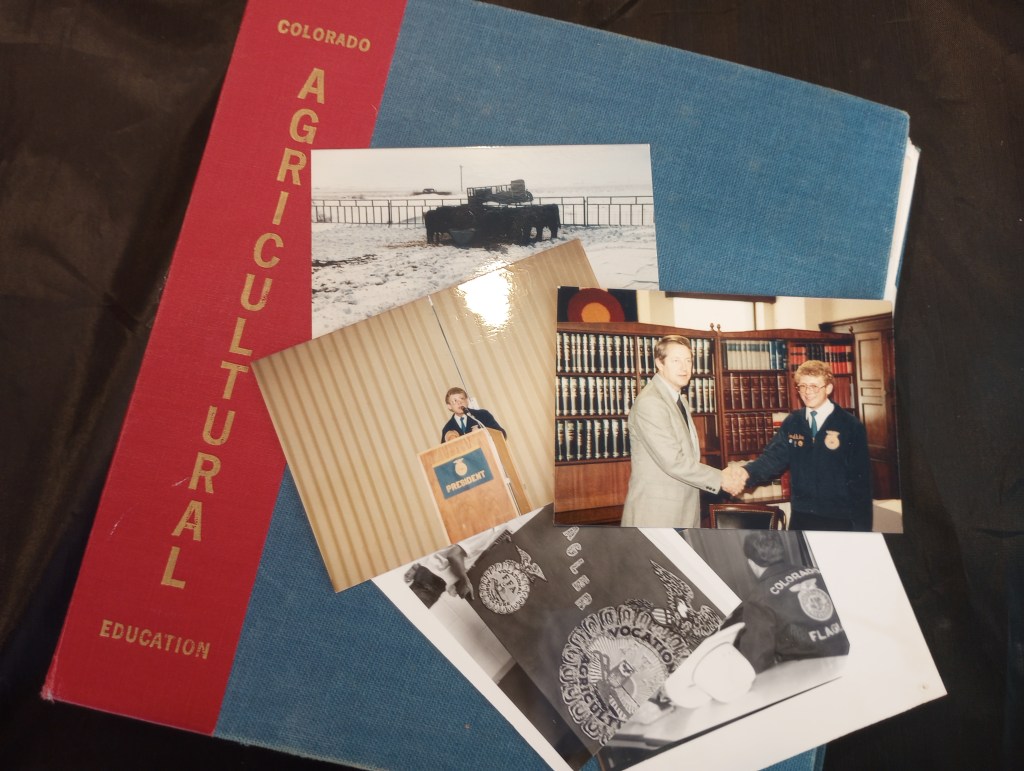
The paths we follow in life often spring from a series of personal decisions. Some are so small that they go unnoticed while the bigger ones are plain to see. The paths we take become set while time and perspective can change how we view the importance of those decisions. In my case, decisions made decades ago to leave the farm life have come back to haunt me.
Being a refugee can take many forms. Mine was leaving a dying school to one down the road, 10 miles down the road to be exact. My school’s death was an early warning of the shrinking populations of small towns in the region that sprang to life with the coming of the railroads in the 1880s and began dying 100 years later. My school dwindled until varsity sports could not function without including freshmen among the ranks of sophomores, juniors, and seniors. Playing basketball and baseball was compulsory and all that the school on its last legs could muster. My father moved my brother and me to the next school, receiving death threats and the label that he was the one killing the school he once attended. An important part in choosing my new school was the existence of a strong vocational agriculture (VoAg) program and Future Farmers of America (FFA) leadership chapter; one of the best in the state. It was a chance to gain a formal education in farming and leadership.
I entered high school as an absolute wallflower and introvert that shrunk from interactions as I grew into a young adult. Maybe living years of isolation on our family farm was a factor. The more I could fade into the background and be left alone to my bookwormish ways the better. The new school would change that. Taking VoAg changed it. Joining the FFA changed it.
On my first day at the new school, I felt lost and bewildered among what seemed an ocean of students and the labyrinth of a sprawling building. I spotted a sturdy brick wall and made every effort to fade into it as just one among many mundane and overlooked bricks. The wall literally had my back. But an adult sponsor knew brick from introverted student and guided me to find my first class of the day, Vocational Agriculture. As my shock of trading a dying school for a vibrant one faded, my VoAg class of about 15 students became comfortable as we formed friendships and rivalries and grew skills and knowledge together. The room served as classroom, after school hangout, and FFA meeting room. I spent countless hours of studying, practicing skills, and building connections. The VoAg classroom became a second home.

Days of practical training to become a farmer or agribusinessman turned to years of concerted study. I believe that my VoAg education was the unofficial equivalent of an associate’s degree with the FFA State Farmer Degree representing the diploma. It was my first formal and cohesive education over real-life subjects that were tested in the classroom with a class grade and more importantly put to the test in judging competitions at the local chapter, district, and at times state level. Crop judging, range management, soil quality, electrical wiring, mechanics, welding, accounting, everything a farmer needed to ply their profession. The notebooks created in class over each school year were detailed, forming an essential reference library for future use.
The school had its usual cliques, like the athletic jocks, the academic nerds, the tough guys, the hot rod car crowd, and the bevy of pretty girls. But then there was also FFAers. I was part of some of those social groups, but was known as an FFAer. The joke among farm families is that FFA stands for “father farms alone” and is often not far from the truth if you embrace what FFA has to offer in terms of practical skill judging competitions and leadership development. I don’t think that my father fully understood what made his bookworm, academic, achievement-driven child tick, but he unquestioningly sacrificed the need for farm help for me to be part of FFA.
Originally I caved to peer pressure to join FFA because everybody in VoAg joined. The lines between VoAg and FFA blurred anyway as what you learned in class was put to use in FFA contests. Our FFA chapter was considered the best in Colorado and a top national FFA chapter, so giving vast amounts of time and enthusiasm to the cause was natural. Along the way to competing for a free FFA uniform jacket because my family couldn’t afford one, the wallflower emerged into a fully blooming flower, or I should say, emerged into a bright and tall harvestable sunflower.

The FFA resonated with me and I embodied its principles of, “Learning to Do, Doing to Learn, Earning to Live, Living to Serve.” In finding a direction to focus, I saw and did things that were wondrous for a kid from the farm. With little money to pay for activities, I had to earn my way into them by winning competitions. I won my FFA jacket in the chapter creed speaking contest, going on to compete at the district, and then state level with the first gold creed speaking award for my chapter. Winning a scholarship allowed me to attend an FFA leadership conference and travel over half of the U.S. to Washington DC on a road trip with eight other FFAers from my area. As FFA President of the High Plains District, I led 12 FFA chapters where I traveled across a large stretch of Colorado on district business and sponsored a leadership conference of my own. Long before the era of smartphones, the Internet, and online influencers, I gave local radio station interviews promoting the FFA and Vocational Agriculture. With each event and activity, my confidence and realization of a larger world grew.
As my senior year in high school came to an end, it was difficult to choose college over being the latest generation in a long line of farmers. For some, it can be said that a skill or passion for a profession runs through a person’s veins. I had the skills in spades, but my passions were elsewhere. Maybe it was my father’s subtle encouragement to seek a life outside of the farm where I would obtain the college education that he tried to follow but found impractical when faced with supporting my mother, me as a newborn baby, and his father in forced retirement due to emphysema. Leaving farming behind was easier in light of the worst economic times in farming since the Great Depression, dubbed the Great Farm Crisis of the 1980s. Having an acute wheat allergy, resulting in asthma and you predominantly farm wheat, was another factor. On top of it all, The Drought of 1983, the worst drought in over 100 years, resulted in widespread crop failures. Prospects at home looked slim. In the end, you choose to farm or not to farm with little middle ground. I chose a path in technology and the urban world, which I knew nothing about, with an allure that was magical.
I didn’t look back on leaving farming for many decades. With so much farming heritage as your family history and growing up in a farming life, many things become ingrained. Coming from a parched land with lots of dust, the prospect of rain and the rumble of distant thunder excites my senses, relishing the air after a good rain and reveling in its smell of earth and minerals that carry a sense of life itself and the hope of healthy crops. When driving in rural areas around noontime, resisting the urge to find an AM radio station relaying the commodities market reports, especially when it is the about Kansas City market hard red winter wheat and feeder calf prices. And the sound of a tractor plowing a field, even if the low growl of its engine is far way, weak and faint, prompting me to scan the horizon to locate it by the dust from its plowing the earth. And I can never really explain to my family that has never been part of farming, as we drive along a highway or road near fields, why I instinctively notice and assess the state of a crop in each and every field we pass based on plant height, color, straightness of the crop rows, and thin growth spots, all as we drive by at highway speed.
Since leaving farming behind, a legacy of 10 generations of farmers including me, I embraced the Information Technology (IT) field. I earned a bachelor’s degree, then a master’s degree, becoming an alumnus of four colleges. I taught evening classes in IT at two colleges for 17 years. Farming was a distant memory, but it was always at the edge of my thoughts, ever far away but near. One day I came to realize that my studies in VoAg and achievements in FFA that culminated in earning the State Farmer Degree were among my most cherished accomplishments. The lessons were practical, tangible, and directly applicable to a world outside of often selfish and meaningless corporate whim, grounded in the cycle of doing, learning, and serving as not just a consumer in our world but as a steward in holistic relationship with everything around us.
Would I change my mind, now that I am older and supposedly wiser? Modern physics is uncovering secrets to the universe, particularly in quantum physics. In particular, the theory that every decision made results in parallel worlds being created. A version of ourselves exists in a world where Fork A in the road was chosen and a version exists in a world where Fork B was chosen. I can only hope that when I chose an urban life that a version of myself continued on as a farmer.
But what do I do as the non-farmer version of myself that chose a different life? How do I recognize the ever present connection to VoAg and FFA that is still part of me? The answer came one day when I accidentally landed on a web page of the National FFA Organization for providing jackets to FFA members without means to obtain one. Even today, not all kids in FFA have the money to afford the blue corduroy jacket required to attend meetings, gatherings, and competitions. Like me when I started in FFA. Donating toward an FFA jacket for the next generation FFAer confirmed just the tip of a truth that I knew all along. The farm had never left me nor I fully it. While I no longer drive a tractor or fix range fence, I am still a farmer not far beneath the surface. I wonder what hard red winter wheat’s price is today on the Kansas City commodities market.
~ Mason
 North of Nowhere - Bridging Different Worlds
Leave a comment