Once, a very old man, who could have been mistaken for a more animated sibling to an ancient Egyptian mummy, said that the last time he had seen me I was, “knee high to a grasshopper”. While many things seem much larger as a child, like the towering cliff of a kitchen counter or an immense piece of summer watermelon, and even grasshoppers used as measuring stick, to me wheat seemed to be taller than it is today. I believe that the shrinking height of wheat today is not an adjustment for childhood memories and I have painstakingly uncovered the reason why. Sometimes, a person’s grip on reality and childhood is challenged, and the outcome could destroy or vindicate old memories.
Late June in eastern Colorado is an exciting time as hard red winter wheat crops near ripeness for harvest. As the dominant wheat class in much of the U.S., hard red winter wheat is planted in the fall, germinates, then goes dormant through the harsh winter, surfacing again in the spring to grow until harvest in summer. When it comes to wheat, the three biggest prayers to Heaven by a farmer are, “Please let it be a good stand” (the wheat is strong, thick, and healthy after the winter hibernation), “Please let it rain” (fall and spring only, and not too much, please), and “Please don’t rain” (harvest time only, thank you).
As a child in the mid 1970s, I remember wading into pale yellow and slightly brown wheat fields near harvest time. The wheat stood thick and tall, undulating slightly as small gusts of wind moved across the crop. Wading into a field, the wheat was almost above my head, maybe four feet tall. In places the long bristly spikes of beards at the top of the wheat brushed across my face, tickling and scratching at the same time. More than once I thought I might become lost in that sea of grass.
Trying to see and follow my father and grandfather into the tall wheat, almost above my height, I watched them pinch off a head of wheat to test if a random sample signaled the field was ready for harvest. Each farmer ground the wheat head into his palm with the head’s beard pointing down. The beard and dry hulls to the wheat quickly break away, revealing light brown wheat seeds. The men then picked a seed, biting it in half or crushing it between their teeth. The difficulty of breaking the seed indicates the relative amount of dryness in the wheat kernel. Dry wheat is needed for harvest. Too dry and the wheat shrivels and loses nutrition, too wet and it will mold in storage. About 11% – 14% moisture is the right amount and these seasoned farmers could guess the dryness from years of experience.

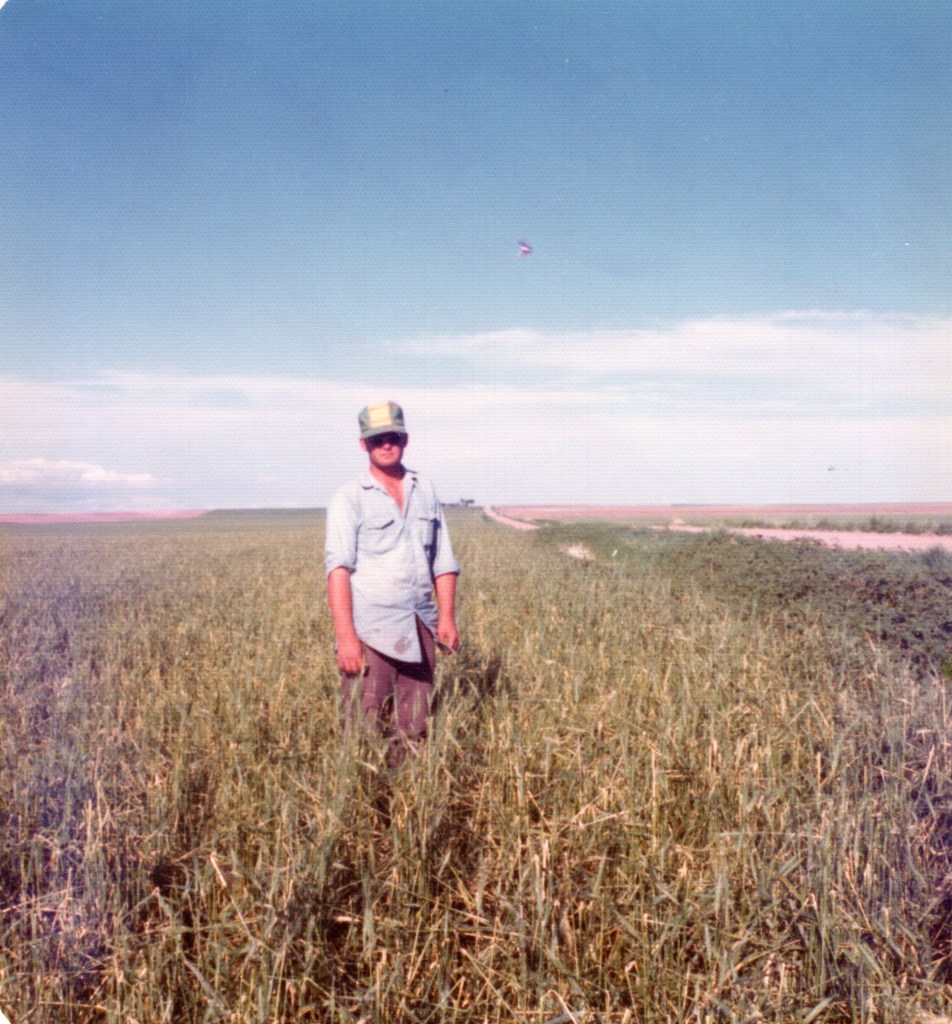
A photograph shows one season, my father standing in a wheat field in the mid 1970s, where the wheat is thick and lush, green in color about a month before July harvest, and approximately four feet tall. But photos taken years later show much shorter wheat. But what could have happened?
Farmers in eastern Colorado have never been able to financially survive on small acreages of wheat. Individual wheat fields could be any size, but were often 160 to 320 acres in size, a field larger than 320 acres being difficult to easily till, plan, or harvest. Our family raised wheat on multiple fields totaling 7,000 acres across norther Lincoln County and the bottom of Washington county. Our farming operation was considered a mid-sized farm in the 1980s. Year to year, wheat height was the same
across fields.
The boundaries between farmer’s fields often blur, forming miles of nothing but standing wheat. Only tell-tale signs would mark boundaries, like a lone fence post at the corner of a field or a subtle difference in wheat along a boundary, created by generations of farming along an imaginary line that now could be perceived with the eye if you stared long enough. The wheat is uniform in height and shorter or taller wheat than other fields would be noticed.
As time passed and I went from “Daddy’s Helper” to “Farmhand”, and as I grew up the wheat grew shorter. It grew much shorter. In the early to mid 1980s, I remember wheat growing to 18 inches tall, maybe two feet at best, and not the four feet tall I remember as a child. What could have happened?
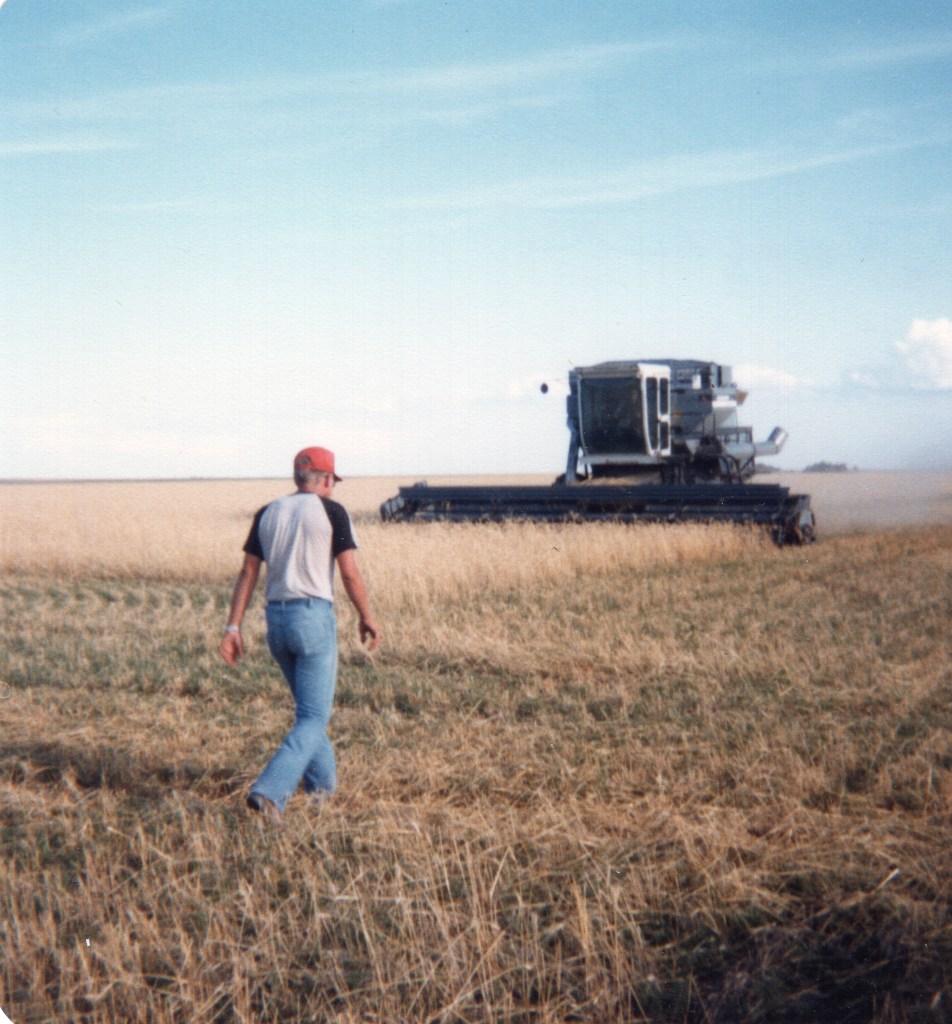
After matching family tales with U.S. Department of Agriculture and Colorado State agriculture records, I discovered that in the mid 1970s, our farm was part of a Colorado State University test program that grew different varieties of wheat as part of the Green Revolution. Vona, Lindon, and countless other wheat varieties were developed as part of the Green Revolution that started in the 1950s to create more hardy and productive crops to feed the population explosion resulting from the global peace after World War II.
Our farm tested a variety called Vona (Reg. No. 599), named after the town of Vona along the newly completed I-70 Interstate in eastern Colorado. It was related to a similar variety called Lindon for the town along Highway 36 in central Colorado. Today, both towns are ghost towns and the Vona and Lindon wheat varieties are a memory.
Vona wheat was a semi-dwarf wheat that was less winter hardy but sprouted several days ahead of traditional wheat and produced 7% – 10% more seeds (yield). The Vona variety required less rain because it grew shorter, but produced a larger crop yield than traditional wheat. The average yield per bushel for wheat in Lincoln county for decades prior to the mid 1970s was about 20 bushel/acre. However, during the late 1970s onward when semi-dwarf wheat became the norm, the average yield increased by the mid 1980s to about 33 bushel/acres.
Our farm began testing Vona wheat in 1976 and kept planting it after its approval and general release to the public in 1977. Farmers in those days kept some of their harvested wheat in reserve as planting stock for the next year’s wheat crop. Although Vona wheat decreased in popularity, only comprising 2% of wheat crops in eastern Colorado in 1989, our family continued to plant it as our only wheat variety. While traditional wheat can grow to four feet tall, semi-dwarf varieties like Vona wheat only grew about 16 inches tall.
My quest began by trying to solve the perception that wheat was taller in my childhood than today and I am vindicated that it was! The traditional wheat farmed before the introduction of Green Revolution varieties was on average four feet or more tall while the semi-dwarf varieties introduced in the 1970s was on average 16 inches tall. My childhood memories remained in tact and all is good with the universe.
Growing wheat, a grass that is prone to damage when ready for harvest, has always been a risky venture, but especially in the semi-arid high plains of northeastern Colorado. Our farm’s willingness to adapt and change by adopting a new wheat variety extended to another experimental technology as well. In the early 1980s, our farm used an experimental technology when planting wheat that promised to speed sprouting times and overall crop volume: Magnets. Yes, magnates. The strength of which can be found in stereo speakers.
During planting time, our farm passed wheat through a plastic collar fitted on the end of a grain auger transferring train, which contained a strong magnet. The idea was that the magnet caused proteins within the seeds to align in a single direction, which would help in early germination and strong growth. From observation and anecdotal experience, it appeared to work when used with wheat crops planted on our farm. Wheat appeared to sprout days sooner than normal. As a high school science project, I grew wheat from seed using the magnet device and using a control group with no magnet use. The seeds using a magnet did seem to sprout and grow faster. It wasn’t until decades later that the whimsical idea of using a magnet at seed planting was widely confirmed by agricultural scientists and is commonly used today. My science project was did not win any science fair awards, but did beat out a project that tested the viscosity of various house paints.
While our farm helped usher in a new type of agriculture that was more efficient and productive, few foresaw the consequences of tampering with plant genes. After all, mankind has a long history of altering plants and animals to suit our needs. However, a side effect of creating the new wheat varieties was an increase in glutens, so much so that many people are slightly effected while others are adversely affected by Celiac Disease. At the time varieties like Vona were being introduced, farmers had no idea of the potential negative effects. Now, the original varieties prior to the Green Movement that began in the 1950s, called Ancient Grains, are slowly returning to popularity.
Our family tried new methods for our own financial survival, but also advanced our trade and the movement to feed a hungry planet. By our farm trying to adapt and survive, we helped the world to do the same. At the time, we really didn’t see the bigger picture unfolding, not even that our wheat was getting shorter over time.
~ Mason
 North of Nowhere - Bridging Different Worlds
Leave a comment