There isn’t a word in the English language that accurately matched my father’s feelings about computers, but let’s settle on the word “detest”. You can use the word “hate”, but “detest” alone gave him the ability to put emphasis on the “st”, like a snake hissing. One Christmas, Dad embraced the digital beast in a selfless gift for his son. It echoed across the years to touch a grandson he never knew.
Dad had long reconciled himself to the understanding that I was going to college. I had no idea what college really was, and no money to pay for it, but I wanted to go to college. In our long family line, nobody had attended college. Ancestors not connected with farming went to college, but 10 generations of my branch of the family wore overalls instead of a college graduation gown. But until I had details about college, talk was cheap.
One day in early 1984, during the spring of my senior year in high school, my history teacher introduced a guest lecturer to his class. He was a software engineer from the company Bell and Howell. The profession and company were absolutely foreign to me, but the guest’s suit and professional attitude caught my eye. He wrote software programs for a company that innovated motion picture technologies in the early 1900s and was now on the cutting edge of computing. I was hooked. The job sounded cool and probably led to fame and fortune. After school, I couldn’t wait to tell Dad that I wanted to be a “computer programmer”. He listened intently to my description of this potential career and I must have been convinced enough by my sales pitch. After I finished my tale of future riches in “high technology”, he simply sighed and said, “Well, I don’t know how we will pay for it, but we’ll figure
it out”.
My farm community was about as far removed from technology as you could get. Every piece of farm equipment was mechanical. The television received three broadcast channels (a fourth channel if the wind blew in the right direction to bring in a better signal). Even if we had lived in an urban area, only 8% of households in America in 1984 owned a computer, most likely where the household income was above $50,000, and that simply was not my farm family in dry, remote, featureless eastern Colorado. But I was not totally without exposure to computer technology. One Christmas in the late 1970s, an Atari computer proudly stood next to our 21” television. It was an entertainment system that happened to include a BASIC programming language cartridge that plugged into the unit. The majority of the cartridges had games like Asteroids and Missile Command and were much more appealing. In junior high school, I once wrote simple programs on a TRS-80 (“Trash 80”) computer, saving my programs to the same type of tape cassette used on other occasions to record hits from the radio. But while computers were just starting to make their way into the mainstream, my high school had no computers. In reality, I might have mistaken the toy Glow Bright for a computer, with no real idea of what a software program did.
After a short, hot and dry summer of plowing fields and harvesting wheat that followed my high school graduation, I began college and studying computer science. The mainframe computer where students learned programming was large, 4ft x 4ft x 10ft, located in a dedicated air-conditioned room to keep it from overheating, with cables connecting it to another room filled with green monitors and keyboards for user access. I had just missed the days of creating software programs on punch cards that technicians fed as one large deck of cards to the computer. Instead, I typed lines of commands at a “computer terminal”, sending keystrokes into what seemed a void, trusting the mainframe and the computer gods to save my lines and lines of code in computer memory. The computer center at college seemed like the cathedral of a new religion where its disciples gathered, offered incantations in the form of programming code, and talked in terms like “SYNTAX ERROR”, “core dump”, and “page fault”. In this new world, I was far, far away from any talk on the farm of the futures price of hard red winter wheat on the Kansas City Market or the going rate of feeder calves in the fall market. My efforts were measured in lines of code and not hours on a tractor. Mom and Dad never really understood a word I said about it all, except that I spent many hours and even days at the computer center working on my software program assignments. A revolution in computing and technology was set to soon explode in computer technology, but it would be far removed and largely irrelevant to the rural agricultural lives they knew.
Coming home for Christmas from my first college semester, I felt a little like the software engineer guest I witnessed in high school. I only had a little programming knowledge under my belt, but now I knew some of the secret incantations of its secret society. I knew more than writing code that displayed “Hello World” to a screen in green monochrome letters. If that software engineer and I happened to run into each other at the local town drug store, we would greet each other with a nod and wink in that knowing way that only fellow engineers would understand. But on my first night home, I only succeeded in helping my grandmother understand that you didn’t need paper to type a software program at the computer keyboard.
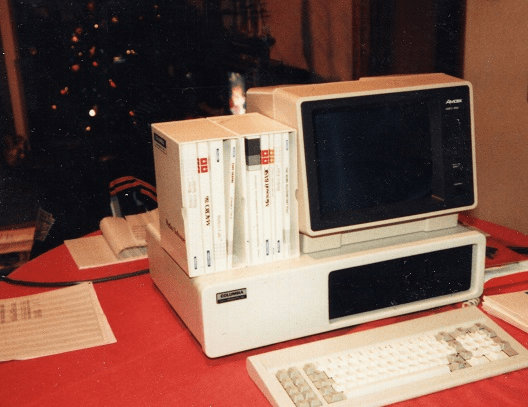
Christmas day was the usual opening of presents that every house enjoys, but at the end there was only one present left, situated behind the Christmas tree. While the intent was to hide it behind the tree, the large box rivaled for attention with the tree and it must have taken an entire roll of wrapping paper to conceal what it was. It was from Santa to me! As I unwrapped the box, Dad pulled from the next room box after box, setting them down nearby. Holy cow! It was the impossible, a desktop computer! There was a computer and “peripherals”, including a modem for communication with other computer networks over telephone lines, monitor, and printer. The computer itself was housed in a metal casing 18″ x 16″ x 8″ that would command the majority of space on most tables. And there was software for writing documents, crunching numbers with spreadsheets, and programming in the BASIC, FORTRAN 64, and PASCAL languages. Dad informed me that “Santa” (as he made an obvious wink with his eye) thought I could use a computer to learn computer science better, and from the convenience of my dorm room.
I was speechless. Desktop computers were rapidly entering the business scene, but were very expensive and mostly out of reach for the average person and household. The software programs they offered were mainly tailored toward business applications with little person value. I stared at the desktop computer like it was a rocket ship that had landed in our living room, holding my breath in anticipation that a little green spaceman might emerge to shake my hand. The rest of the evening turned into Dad and I installing software and getting it ready to box again and take back to school.
After an hour of reading the manual and fruitlessly trying different commands, we had gotten nowhere in bringing the beast to life. Each typed command at the prompt resulted in some kind of error message. Another hour of trying wasn’t any better. Soon, several hours had passed and it was 11pm. Then midnight, and still no success.
Farmers swear when frustrated. Dad wasn’t swearing. He was beyond frustration and swearing. Swearwords tailored for use by farmers for computers had not been invented yet. I had never before seen the reactions from him. He was silently crestfallen, anxious, and at his wits end. Although he never showed a sign, I sensed that he was afraid that he was not capable or wise enough to make this gift work for his son. And there was nobody in our small town, farm neighbors, or my former high school who would hold the answers to our problems.
At 1am, in defeat and resignation, Dad stepped outside to smoke a cigarette. I sat there looking at the amber monitor and the words, “SYNTAX ERROR”, wondering what it was trying to tell us. The user manual was terrible. The sentences were in broken English, likely translated from another language, and with a different audience than a farmer and his “wet behind the ears wannabe programmer” son. But if I had learned one thing from programming classes so far was that capitalization, spacing, and sequences of characters and commands are specific and matter. So far, Dad had been in the command chair, but now I was at the keyboard. Following the manual, I typed the command to move to the directory specified. There was no error response and just a blinking cursor! O.K, let’s try the next command. As Dad entered the room, he heard irregular grunting-like noises from the computer as it read data from its “floppy disk” media and began starting the operating system by booting MS-DOS! With a shared feeling of relief and joy, we watched line after line of status scroll by on the monitor. Commands were completing, devices were tested, ending with the display of a blinking command prompt on the screen. It was functional!
Dad and I didn’t mind working through the night to install, test, and play with the rest of the software. The next morning, we shut the computer down and made it ready for transport back to college. He was proud that I found the correct keystrokes to make progress. He was proud that I was already on my way to using it for a future that he might not fully understand, but I did, and that I would make the future my own.
As a young and naive farm boy setting out to college, I didn’t recognize the hope and anxiety my parents had for me being the first in our family to go to college. They really didn’t know how they could help me navigate a world they would never know. That computer was their only experience with it, never having bought a computer even after they were common, the Internet arrived, and the world became easily accessible online. Years later when Mom moved to an assisted living facility and I prepared her house for sale, I found the sales slip for my college computer. In 1984, a gallon of milk was $1.89, bread was $0.66, and the average new car cost was about $6,300. The computer they bought for me cost $3,800, adjusted to almost $11,000 in 2022 dollars. They didn’t have the money for it, struggling most years to simply make ends meet. They took out a three year personal loan to finance the computer’s purchase. That Christmas night when the only words displaying on the computer monitor were “SYNTAX ERROR”, Dad kept me from seeing the gut-wrenching test of nerves, anxiety, and feeling of utter helplessness that he underwent. I may never be able to repay such an act of giving from parents to son.
Now, 40 years later, it is my own son’s turn to begin college. For Christmas, I bought a computer for him to use at his studies. This time, things are different. We live in a world immersed in constantly changing technologies. Computers are part of my daily work, and his learning from childhood. The machines are affordable and the average person upgrades to newer models relatively often. The once stationary computer dominating a table top is now a laptop you carry in a backpack. What hasn’t changed is a parent’s wish to do whatever they can to forward a child’s future. The anxiety of wondering if you have done everything you can for them is still there. The hope is still present that whatever you do for your child may make a difference in ways you may never imagine or see. Farmers are optimistic gamblers, betting that the future will be better than today. Dad bet on my future, and now I’ve done similar with my son. Things sometimes come full circle and repeat the past. The long ago act of giving a tool for a son’s yet-to-be defined future repeated itself. Thank Heavens this time around there was no
“SYNTAX ERROR”.
~ Mason
 North of Nowhere - Bridging Different Worlds
Leave a comment