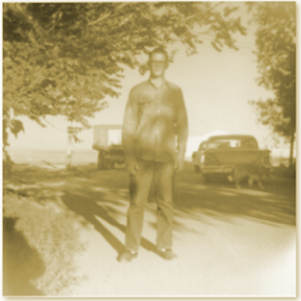
I cut myself today, watching the blood with anticipation. It started as a tiny speck of red life escaping from the cut and grew into a perfectly round drop before falling under its own weight onto a white paper below. It proved I was alive. It emphasized the moment at which I became one minute older than my father. I was now older than he would ever be. After him being gone for almost 20 years, today the mantle from father to son fully passes. The red proof of life gave no hint of the diagnosis the week before that my father’s undoing was taking hold in my own veins.
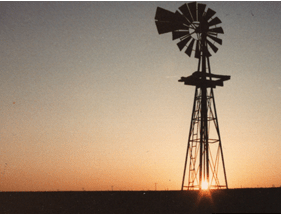
There were many opportunities on our wheat farm in the vast and open High Plains where Death could have called Dad’s number. Small margins of error exist when working in an isolated field with the closest neighbor two miles away, the closest town 20 miles over the horizon, and a hospital at least 30 long miles away and over mostly gravel roads. Dad liked to push his luck, putting himself and often my brother and me in impossible situations where the least breath of wind would have brought it all to a tragic end. And yet, Death would somehow forget that Dad was almost requesting a formal invitation to meet, maybe be on vacation when Dad executed his most precarious repairs with no chance of help if something happened, or even napping when Dad was tempting a possibly fatal act.
Don’t get me wrong, Dad was not careless or “Devil may care”, but the King of Improvised Repairs and Manufactured Solutions when working in the field and the proper tools were not available, making calculated risks with his life as table stakes. Once, Dad and my brother and I were replacing parts on a seed drill used to plant wheat. The worn, broken, and rusty parts were underneath the heavy steel framing that supported a difficult-to-access maze of sharp metal disks used to till the earth, pointed tubing to deliver the seeds, and springs and wires to keep everything in place. Dad’s substitution for the necessary winch needed to lift the equipment, which we did not have, was a heavy bumper jack. The same jack often seen strapped on vintage off-road jeeps had the ability to lift almost anything to the dizzying height of three feet off the Earth, which was just enough for the three of us to climb under the equipment. As we uneasily pulled, pushed, hammered, and gently wrestled rusted and stuck parts off of the drill, we kept an eye on the jack. One jerking motion too many and the jack might betray our trust, sway to one side or another and fully fall, with the equipment impaling all of us under several tons of cold and uncaring steel. Yet nothing happened and we lived, with Dad’s luck, another day. Death must have been on coffee break.
Working on a wheat farm in eastern Colorado took its toll over time on whoever embraced the lifestyle. If you were not injured in a serious accident, it was the small dents, dings, and mars that took a toll from a hard life of making a living in marginal growing conditions. The work aged you, giving a person in their 40s the body and arthritis of somebody in their 50s or older. I witnessed Dad suffer accidents that were minor for the profession but would otherwise be considered four alarm fires anywhere else. Once, I helped him replace a long line of triangular serrated blades that formed the primary cutting arm, a sickle, on harvesting equipment. Each blade’s removal required severing the three heavy rivets that held it in place, followed by installing a new blade with three new rivets driven into place by the forceful swing of a strong arm wielding a two pound sledge hammer. If you miss, you smash the hand holding the blade in place. Once, Dad missed. Suppressing a scream of agony, he held his hand, likely broken, to his body and rocked back and forth until the pain was manageable. He returned to work without a word said between us. Another time, Dad fell four feet on his back onto concrete, cracking a vertebrae and rupturing a disk, only to be seen at work the next day. However, the sum of these injuries over time did not cause the withering of his body or take his final breath.
Everybody has their heroes, and my father’s was John Wayne. In those days, World War II movies regularly played on television and if you wanted a true-blue American, whether in the wild west or the World War II, it was John Wayne. In many ways Dad seemed to emulate the straight shooting, silent tough guy who stood for what was right and against the odds. As Dad aged, he even began to vaguely resemble The Duke. In his movies, The Duke was self-sacrificing and in the end saved the day. John Wayne in the movie, “The Fighting Seabees”, dies while driving a bulldozer to save the day. In those movies The Duke made his time, and life, count.
The day Dad died, instead of a bull dozer he was driving a large road grader to landscape around a neighbor’s home. His illness had been a long struggle that reduced a man with 300lbs of muscle, bone, and sinew to 165lbs of rail-thin weakness. Although known as a “bear of a man”, his illness reduced him to somebody who could barely walk. Dad must have struggled when Death caught up with him and applied a bone-breaking squeeze to his chest, making it impossible to breath or even think, loosing bodily control as Death squeezed harder and harder. In his last minutes Dad emulated his hero The Duke and did not give up, wrestling the moving machinery to a safe stop, likely preventing the heavy and moving equipment from blindly driving through the home. He was found slumped over the controls, age 53, dead from a massive heart attack. His demise had been building over many years with his arteries slowly hardening and his heart becoming more and more rigid to the point that Death could not let Dad slide any more, zeroing his account.
Waiting for the moment after which I am the same age as my Dad, and to live past it, was a strange and foreboding goal for several years. It was to mark a solemn moment when I was truly no longer the junior, but the elder. It was wondering in the back of your mind if Death has a shorter life in mind for you as well and your parent’s death is the barrier you need to pass to break the curse. Maybe passing that moment in time frees you to write your own fate and not be tied to your parent’s path.
While now one minute older than my father and counting, I recalled learning the week prior that I too now show the beginnings of heart disease. I learned that it is in my genes. It has little to do with the hard environment of a farm, or even the lifestyle choices that you make. Perhaps the curse is not broken and I have only postponed my appointment with Death. Maybe our meeting is sooner than later.
Since ancient times, people have understood that life is frail and can be lost too soon, too easily. As legend has it, a victorious Roman general returned home to a parade where at one point he was told that despite whatever is said or done, we all die. Over the centuries, the depiction of a skull has been used to remind us that time is shorter than we think and that we all must die – “Memento Mori”. When visiting old cemeteries in Europe that reach back to the days of The Great Plague you find tombstones depicting skulls, often with crossed bones. In World War I it was common for soldiers to wear a skull pin to remind them of the frailty of life. Today the images seems grim, perhaps even B-movie melodramatic. But the image of a skull does not simply depict death. Thei message, even at the height of the plague when it seemed like the world might be ending, was to remember how precious life is and never take it for granted. No matter how much indeterminate amount time we have, in the end we never have as much time as we think. The focus of life should be a balance between realizing how short it is, savoring every moment, and focusing on what is important. What matters is how well we use the time we have. In addition to, “Memento Mori”, or “we all must die”, the phrase, “Carpe Diem”, or “seize the day”, is just as key.
Despite all of the advances of science and the $1.2M machine that scanned my heart for signs of cardiac issues, I really have no more idea than before how long I myself might live. Most of us really do not know. But in the end, it does not matter how much time we have to live. It really is up to us how we use the life we have in the moment we are alive; the current moment is really all we can count on. Do we blindly pass the time given us or do we become John Wayne and seize the chance to be the hero in our own story?
~ Mason
 North of Nowhere - Bridging Different Worlds
Leave a comment