A lot of the rural life does not see much excitement, especially where I grew up in the “middle of nowhere” USA. It was a big deal when a local town began offering “free land” to businesses willing to relocate and invigorate life with new jobs; that one made it into a “where to live” YouTube video. And then there was the event, lifetimes ago when Elvis was still alive, that a driver transporting his custom convertible across country stopped in my town for gasoline and fan photos. But every year in July, rock stars appear across the area to enthusiastic fans and everybody, young and old, are caught up in the activities.
In one such instance, the performance begins in a large open field where the rock star arrives to see already waving multitudes into the distance. The performers can’t help but feel a thrill every time a venue is entered and the lead star starts wading out into the stands. Suddenly, the music roars to life as the crowd body surfs toward the star atop the platform. They eagerly are transformed from delicate and easily crushed individuals into a collective rush of life-sustaining force that swells in number and gathers behind the stage area intended just for them. At least this is how many young farmers riding harvesting combines would like to think of themselves at wheat harvest time.
At wheat harvest, the combine jockey that cuts wheat and separates the precious grain from its straw body, making it ready to store or sell, is indeed a rock star. It is understandable that the wheat truck drivers might argue that they are the key element, not unlike the sound crews of a rock band with their huge speakers and mixing boards. But if a farmer sees combines full of grain suspended from cutting more wheat, no trucks ready to receive it, and eyes a threatening storm on the horizon, he might be tempted to empty the load on the ground and keep cutting, opting to later use a motorized grain auger to load it into a truck. Wheat trucks wait for the combines. And like rock stars, combines wait for nobody.
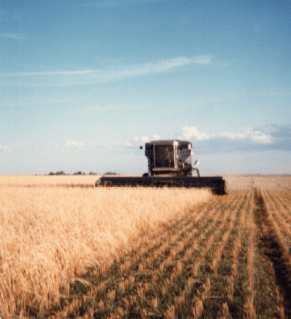
As a young farmer, my concert stage was an older but effective venue. It was an Alice Chalmers L1 combine from the mid 70s that could hold 120 bushel of wheat kernels while cutting and processing a swath 25ft wide at one time. I only needed to empty my cargo four times to fill an average truck. With panels made of galvanized steel covering a network of gears, cogs, and long vulcanized connecting belts, it gleamed in the sun just as well as any rock performer’s stratocaster guitar. But my tools of the trade came with a strong and powerful diesel engine that gave a deep and throaty “ruu. . .UHMMM!” whenever I eased the throttle and my mobile platform gave a lurch into motion. Situated above large front wheels 5ft wide, it placed my performance platform high above the ground, making my work visible for miles to any fan of harvests.
The platform was an enclosed cabin to protect me from the elements. Surrounded on three sides by large glass windows, only the wall behind me was solid steel with a wide but narrow window just above my head to look back stage at the growing collection of wheat in the grain bin. A true performer is not fully embracing their craft unless they work up a sweat on stage and I did so as the cabin did not come with air conditioning. I could open a side window to my right or the narrow door to the cabin on my left, but the roar of the engine and dust from cutting dry wheat would flood the enclosed space. I completely understand why performers wear ear plugs to protect them from their own sound generation. By comparison, my father only 10yrs earlier had been a younger star of his own production, riding a small red combine with no cabin and only a 15ft wide header. Compared to my modern Tower of Power, it could be considered a “starter” guitar (with portable hip amplifier) for small performances, I still would see a farmer from time to time at harvest using one, a dust-covered figure playing a slow but loved oldie in the hot sun.
Every morning during the harvest concert season started with a preshow instrument tune-up as soon as the rising sun drove the dusk away and the clear day broke. Like trying to ready any instrument, its own personality sometimes means tricking tuning. Turning the key and edging the throttle inside the cabin resulted in a robust engine start or a sputtering cough. For reluctant starts, you climbed out of the cabin, down the steel ladder to the ground, up another ladder with middle platform and up steps to the huge 4ft x 2ft x 4ft engine to spray ether, the farm engine equivalent to enhancement drugs for some artists, into the air intake of the engine. Then off like a shot, the engine would roar to life when you turned the key. Further instrument tuning included checking all belts for cracks and proper tightness, greasing key components to prevent friction which could result in breakage or fire, and cleaning the huge windows of dust. Easing the stick shift into low drive, and letting out the clutch, your mobile platform would give a slight lurch forward and you were ready to rock and roll.
There are those times when a show is not ready to start and everybody waits. And waits. And waits. Usually this is due to technical difficulties when it is discovered that a belt is ready to break from wear or inspection of the running machine finds an out of tune noise in a metal component, usually a bearing, likely deep in the machine, ready to break. Like trying to find a short in lines on stage to guitars or speakers or the sound board, the music stops and everybody gets involved. If there was anything like a stage or venue promotion manager, it was my father, impatient and urging us to get going as he saw revenues slipping through his fingers in the form of crops not being cut. There was no better music than when the machine started to cut again.

I have to admit, I wasn’t a bad performance artist when into the groove of running my combine. Below you, the wide and delicate rotating paddle wheel in the combine’s front header gently collects rows of grain that are cut and directed it into the center and body of the machine where grain is separated from straw. The machinery makes a deep rhythmic thrumming sound that processes the wheat, punctuated by the lighter sounding melody of grain as it spills into the metal collection bin behind your cabin. The effect of sound, movement, and vibration come together as a song with a repeating and comforting feeling, making you not a small component surrounded by machine but the heart of a complex whole.
It is easy to imagine the stocks of wheat body surfing at this harvest concert toward the stage where I control every aspect of what takes place. Sitting in the cabin, my feet controlled clutches and breaks while my left hand guided the steering wheel to drive a perfectly straight line, not missing any wheat stalks. My right forearm rested on a pad while my fingers gingerly moved between three banks of toggle switches, 12 switches total, that controlled the speed, height, and critical motions of the front header collecting and cutting the wheat. My eyes critically surveyed the wheat to give direction to my hand at the switches. My ears listened for any noises that might sound out of tune and a problem developing in the equipment. Every element came together to form a music that I had mastered and now played by instinct.
Once when the day had been sunny and dry and the wheat could be cut into the night, we didn’t stop with the main gig for the day and played encores as long as the night air’s ambient moisture absorbed by the wheat stalks didn’t make them too tough to cut. Despite the multiple flood lights showing on the wheat in front of the combine and 20ft ahead, the absolute pitch blackness of the night enveloped the machine. It was just you and the swaying wheat, your crowd. Nothing else existed. As cutting continued, the night and its countless stars gave way to a large orange harvest moon. Like the experience some feel at that one particular concert they can never forget, the unexpected moment etched into their memory forever, I have never since felt quite as much purpose, energy, or magic at one time under that kind of moon.
Farmers at harvest time are never alone as a single performer. They have an entire crew working just as hard to pull off a spectacular concert, manning grain trucks, service vehicles, repairing equipment or driving long distances for parts, coordinating trucks and tallying grain receipts, or providing the meals and drink so necessary to keeping everybody going. Their energy is everywhere and doesn’t need amplifiers to be strong, resonant, and vibrant. At the end of a long and hard day of cutting wheat, exhausted from having worked over 12hrs on a good day when the wheat was dry and the crews could continue into the night, the buzz in your ears from the machinery and in your heart from the work it is hard to give up to get some rest. You are on tour and tomorrow is another day on the road and in the field until your Harvest Tour is over.
~ Mason
 North of Nowhere - Bridging Different Worlds
Leave a comment