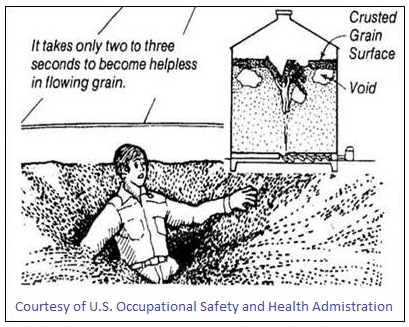
From time to time the news highlights occupations or their practices that are inherently risky, especially in farming, that sometimes end in tragedy. One of those is “Walking The Grain” where a person assists the movement of grain inside a storage area, runs the risk of becoming trapped in the grain, and suffocates. A common reaction among my urban friends is, “That’s barbaric! Why are people allowed to do that?!”. And, “They should just refuse. There should be a law to prevent it.”. While I now work in an office cubical, once I Walked The Grain. My natural feeling is, “Why not do it?”.
Growing up on a family farm, which is mostly exempt from OSHA (Occupational Safety Health Administration) regulation, there were many ways to “bite the big one”. My last comment was not trying to be flippant, but merely echoing a reality and fatalistic view of many who make a living in rural areas. Getting hurt or worse is a sad part of the life. Family farms could not financially survive if required to comply with OSHA safety regulations. Many farms struggle to hold down expenses while raising more because sale prices have not changed on many commodities in decades. At an early age, children begin working alongside parents and continue that manual labor all of their lives. You can look back in old age and count yourself lucky if you have everything you entered the world with and it all reasonably works.
Everybody, urban and rural, as they enter the age when AARP membership forms regularly materialize in the mail, would love to be and look like the aged, confident, and viral man in the commercial driving the pickup with the horse trailer that gets stuck in the mud; he gets out of the truck, uses the horses to pull out pickup and trailer, barely breaking a sweat. He’s home for dinner and with his lithe form, maybe even has a romp in the barn’s hay with his gal before bed. REWIND. . .On that farm, the real one, the guy who looks like a 55yr old Wall Street type in denim is really 40yrs old and does not stand up nearly as straight after decades of hard labor, cracked ribs, pulled muscles, and maybe a few dislocated joints along the way. After rigging a makeshift harness out of the gear on hand, he limps home and into bed with too many aches and pains to count.
In any business, stretching resources means taking risks. In rural areas, those risks translate to expending mainly physical capital. It’s not really a question in most rural areas of working a desk job, seated in front of a cubicle – often jobs where you primarily sit to work literally don’t exist. Instead, you rely on a strong back and dexterous hands to work, standing, stooping, lifting heavy items and getting on your knees. Day in, day out, the “free gym membership” wears a body down, aging a person. A coworker in my office once joked about needing to go home due to a paper cut and not being able to function. My mental knee-jerk from working on a farm was, “Well, that’s why God gave you 10 fingers – one down, other’s to take over”.
Not everybody lives this way, but in traveling the U.S., I have known too many people who have. Growing up in Eastern Colorado wheat country, I first steered a pickup at age 4 helping my father to deliver hay to cattle, was taught at age 11 how to actually drive a large pickup, and was Walking The Grain at age 15. You learn from your own injuries, and hearing about the tragedies of others, to do what needs to be done. It’s not heroism or cockiness, just understanding that if you don’t do what you need to do right, it could “really hurt”. Even today, like when helping a friend move a heavy sofa down apartment stairs and they express concern on “what if”, I respond, “Well, just don’t screw up”.
A recent news article about Walking The Grain brought back memories of a warm May morning when I was 15yrs old, wide aluminum grain shovel in hand, inside a grainery 32ft wide and over 50ft tall on my family’s farm. We were removing grain by a gas-powered, cork-screw-inside-of-a-pipe auger from a compartment at the bottom to deposit into a waiting grain truck. Condensation and humidity caused the grain to harden and stick to the grainery walls. With my shovel I knocked the wheat from the walls, trying to keep my balance as it shifted. I felt like I was in the top half of an hourglass as the wheat moved down and toward the center. As the wheat moved, a slow, but mesmerizing motion lulled you into thinking that the grain was nothing to worry about. At one point, I slipped and sank to my knees, finding it hard to stand as everything was moving and sinking. Like quicksand, the more I struggled, the more I started to become buried. The grain, spilling into my boots, made them work against me like anchors, fixing me in place and pulling me further down. I realized that I was being pulled under the wheat or could be sucked down into the auger at the bottom. Suffocate or mangle, which is it? With sheer effort and some fear, I struggled free and after a short breather returned to the work. That day, and other times with situations like it on our family farm, I learned just how fragile life can be.
But we all do our share of “Walking The Grain”. In a rural life, a mistake or accident and a very painful death or mangling results. I tend to call it “Instant Karma”. An action gets an immediate reaction. Hopefully you learn, remember, and are around again to know better. In an urban life, things are more like “Delayed Karma”. For many, work happens in offices, cubicles, and in front of a computer screen. The phone is an audible extension of a customer that wants something NOW! You rush to work, no time for breakfast, lose yourself in countless pulls for your time, suffer a clueless boss, then rush home to maybe make a quick bite to eat. Children, partner, and a dirty home want a piece of your tired body. Dead tired, you fall asleep to the TV. In some cases, the stress follows you home like a private detective tailing a suspect, then as a thief that sneaks into your bedroom to steal peaceful sleep. The Great Recession and the fear of losing your job makes many people work without taking vacations, finding themselves needing to “use or lose” the days off and working hard to “catch up” before they can go and relax. Those people Walk The Grain, too, but the dangers are more subtle and hidden. Where in the rural life people can experience a farm tragedy and suddenly die, the urban life can kill by slow degrees. The stress eats away at a person and diabetes, heart disease, and cortisol pulsing “belly fat” take their toll.
I don’t think anybody longs for the days of Walking The Grain and would make it so nobody would have to be subjected to it again. But we all have to take risks, make sacrifices, and whatever else it takes to get through a day. Until the world changes and truly puts more value on the person and not the work, all we can do is hold our loved ones a little closer, a little longer. Instead of horning at the close call in traffic, maybe resolve to savor a sunset, the smell of fresh cut grass or a coffee on a cold morning just a little more. In the end, Walking The Grain in whatever world we live in holds a lesson on how to appreciate and savor life, not despite its risks but because of them.
~ Mason
 North of Nowhere - Bridging Different Worlds
Leave a comment