
“Kin, yer dad died”, was the shakey but firm explanation that Mom gave in her Oklahoman accent when I asked why my brother left a message on the answering machine to “call Ma”.
My name was Kenneth, but in the dialect of the area it was “Kin”. That was it: Dad-had-died. Typically, Mom’s words stated only the bare essence of what had to be said, relying on the weight of their meaning or telepathy to convey the rest. With follow-up questions, Mom explained that it was a heart attack while landscaping a yard in the area, but it was O.K. because he had stopped the equipment he was using before actually dying. I have never heard of an urban coworker making sure that he saved an open file before he could meet his eternal reward and not until then, but that attitude of “you’re not finished here yet, mister” could be the epitaph of many a farmer. Arrangements were made, reservations booked, and my wife and I were on the next flight to Colorado.
Dad died in the small rural farming town where he had been raised. The years had not been kind to him. His body was old before its time, wracked with a wide variety of poorly healed broken bones in his hands, fused vertebrae in his back, and scars from serious but in the end debilitating near-miss farm accidents. Combined with increasingly hotter summers, poor weather and low crop yields, and rising expenses, he knew that the end of his farming days were near. Dad did not foresee the severe diabetes that ravaged his body, wasting away his large and strong frame to that of a weakling. A creeping paralysis slowly worked its way up his legs and would one day reach his heart. His final day started with the usual coffee and Camel cigarette for breakfast, and deciding whether to take the essential diabetes or pain medication pill; Dad could not take both because he could not afford to refill both prescriptions, actually either, at a time. Dad went on to an odd job of landscaping for a town local, operating the large and yellow type of road grader that you see used by county road crews to move and smooth soil. That was where he was later found, dead from a heart attack. Dad had enough time to stop the large machine and slump over the controls, engine still running, where he died alone. He was 53 years old.
The drive from Denver to the town of Arriba, population 230 on a good day, is two hours. For interstate travelers passing through on this route, it is flat, treeless, featureless, windy, and mind-numbing when combined with the same terrain that comprises western Kansas. On closer inspection, the land has a grassy beauty that once induced immigrants from the steps of Russia to settle there and an open vastness that beckons you to feel an integral part of nature and God. But the day before Dad’s funeral, it was cool and breezy, with a sullen and leaden sky.
While I drove along the two-lane ribbon of Highway 24 that rolled and meandered away from the Colorado Springs airport and toward the eastern plains, I was reminded of the difference between the urban world I now called home and the rural world of my roots. My wife was not a child of the American West, although she admired its rugged individualism and limitless vistas. While Dad raised wheat, barley, millet, and cattle, with my brother and me as farmhands, her father was an electrical engineer in the Washington D.C. area. She visited the Smithsonian Institute as a child while I saw Cave of the Winds in Colorado Springs. A Colorado farm funeral was not high on her list of “must see” travel destinations – Not State Department recommended.
“How many people are at your mother’s?”, she asked.
I replied, “Oh, only a few. Maybe four or five. Sounded like some of her brothers and their wives”, neglecting to mention that really at least eight or more people had rushed to Mom’s house for “support” and it sounded like a tobacco auction when I first telephoned.
My wife reflected, “That many people in that size of house? How many are staying? We need a hotel room.”
She was an only child from a small family. Although Dad’s family tree was small, Mom is from a family of eight siblings, most living close by, all with names that begin with “D” and an innocent yet probing curiosity for people from “Back East”. They raised large families and embraced an extended family network. She knew this and I could tell that her head was starting to spin.
I assured her, “Hotel – sure. It will be fine. Really”.
Although a light drinker, mostly a teetotaler, she answered, “I want alcohol. Beer. Wine. It’s allowed in these types of situations”.
The Super 8 motel was a safe but short distance of 20 miles from Mom’s house. I planted the seed with her before my wife and I left for Colorado that we might stay at a hotel, but it didn’t help.
“Yew shur? We thought yew might stay in yer Dad’s room?” asked Mom.
Not only had Dad been an active resident of the room, and more importantly its bed, only a few days before, it was the hottest room in the house with the ability to roast four turkeys in as many hours.
I replied, “No, Mom, we’ll be fine. Besides, I thought Aunt Doreen would be staying over. Where will she sleep?”
Mom quickly answered, “Oh, she doesn’t mind bein’ on the sofa”.
Hotels that are frequently the first to offer comfort during a family death in an urban setting are the last to profit in a rural community, falling victim to frugality and independence, even in the face of grief.
It felt comforting to arrive at the house, although I hadn’t called home for over a decade. The white one-level rambler with turquoise trim and a large beige machinery shed that could hold several Metro buses, the long reticulated ones that bend in the middle, still stood alone but surrounded by tilled wheat fields. The blue spruce trees planted by my grandmother decades before were broad and over 30 feet tall, despite the low rainfall over the years that emphasized the phrase, “dry land farming”. As usual, the breeze was brisk.
Soon after parking the rental car, a sub-compact Chevy Cavalier, my brother stepped outside to meet us. At 5’9”, he was excessively thin, with a wiry body which made him look much taller. At times the family would tease him that his brown-blonde hair, long in the back and curly, caused him to look like the actor Michael Landon in the television series Highway to Heaven. Dad would joke that he needed to run to the garage and find his sheep clippers to restore conservative order to his hair and the family.
As my wife and I stepped out of the car, he observed in the same Oklahoman accent used by Mom, “Nice car yew got thar, bet it ain’t cheap.”
While someone in an urban setting might ask first if we had made the trip well, the rural mindset plainly sees that you arrived in one piece. A car is a different matter and requires attention. A constant eye to noticing and assessing value might be useful later when negotiating with a salesman or the original owner of an item.
My wife, brother, and I entered the house’s kitchen through an enclosed front porch, and found my sister in law, Daphne, and Mom solemnly seated at the mid-century kitchen table. Playing among the chrome-legged, vinyl padded chairs was my two year old curly-headed nice, Becky. Although the sound of choice in urban homes is a radio or stereo playing music, the acoustic standard in many farm houses is the erratic, gravelly drone of the two-way radio scanner. Mom’s scanner, echoing from the den, was monitoring the state patrol as they conducted speed traps on the nearby interstate highway.
After exchanging teary-eyed hugs and “how are you doing” comments, we sat down and Mom asked, “Would ya like somethin’ to drink?”
The beverage possibilities were easy and never changing: Instant iced tea, tap water, or milk (only consumed at breakfast). In our family, strong iced tea, to the point of being dark brown and murky like Texas Sweet Crude, was the beverage of choice and available by the gallon pitcher; unlike Oklahomans or Texans, it was unsweetened tea. Little had changed except that Dad was absent, as if he were working at the farm and would arrive at any moment, tired and dusty, in khaki green work shirt and pants, wearing a free tractor dealership trucker’s cap, and interested in a glass of tea.
It was late evening when my wife and I drove back to the hotel. Along the way we mulled over the visit and arrangements for the funeral in the morning.
“Your mother is handling everything well, almost matter of fact about it all,” she commented.
Unlike the office, where workers are constantly at risk from bad coffee, paper cuts, or even muscle pulls from lifting water cooler bottles, farm accidents are frequent and result in severe injuries, chronic health problems, and even death. These realizations were a part of my upbringing and Mom understood them. It was now her turn as a farm wife to endure the aftermath.
I replied, “Yeah. I’m surprised that Bro will be giving the eulogy. He offered for both of us to speak, but I’m not prepared to write something. Let alone stand up tomorrow and speak.”
She added, “Isn’t it enough that both of you are pal bearers?”
“Well, I guess he just wanted to give Dad a good sendoff,” I reflected.
It was only 8:00 p.m. when we reached the hotel and the surrounding town had closed up shop for the night. The nearby truck stop looked like a brightly lit oasis, offering microwave burritos and salted pecan logs, Zippo lighters with Elvis motifs, and several brands of domestic beer. It was a long, long way from the microbreweries, drive up coffee stands, and vegan eateries of Seattle.
I leaned inside the open driver-side door of the car after I had inventoried the options, “So, what’ll it be? Coors, Budweiser, Bud Light or Michelob?”
My wife answered, “Do you know that your voice is starting to sound twangier?”
It was a Coors night.
The morning of the funeral started out sunny with a robin-egg blue sky and a cheery warm sun. While driving to Mom’s house to meet before the funeral services, I felt the infrequent bump of the numerous road patches along Interstate 70. The aroma of hot coffee that I picked up at the truck stop mingled with the rays of sun filling the car, making me sleepy. An overly excited DJ on the radio declared that the previous day’s temperature of the low 50s F would be replaced by a high of over 90 F and little wind.
“Yes, folks, it’s gonna be a warm one today!” chirped the DJ.
Air conditioning, even window units, is rare on rural farms of eastern Colorado. Instead, many homes own rural “swimming pools”, recycled livestock water tanks in their back yards, for the children to splash in and play. In many rural areas, house windows open around Memorial Day and stay open to provide cross ventilation (i.e. free air conditioning) until after Labor Day, or so the theory goes.
Arriving at Mom’s house, I noticed that the house and machinery building were silent. Although several cars were parked in the graveled yard, everything seemed deserted. No breeze, no sounds, no dogs. In dark suites and sunglasses, my wife and I probably looked like FBI agents in an X-Files episode investigating disappearances due to UFOs (which were known to be seen from time to time in the area). Stepping inside the house cued the radio scanner to erupt in a burst of chatter.
My niece Becky energetically toddled by with twinkling eyes and chocolate smudges surrounding her little mouth, calling “Mama! Mama!”.
As we followed Becky into the kitchen, she was scooped up by not a space alien but my sister in law, Daphne. Dressed and ready for the funeral in a light grey dress, she attempted to clean Brittany’s squirming face.
I asked, “Where’s Bro?”.
Before she could answer, my brother burst from the bathroom in his faded blue jeans, water dripping from his hair onto his bare chest, exclaiming, “Whar’s the underarm stuff?!”
Whether a battle field, the best urban household, or the most humble rural home, chaos can reign supreme.
When Mom hurriedly entered the kitchen dressed in a quilted, bright pink robe and baby-blue slippers, I noticed from my wife’s momentary expression that she had not seen Mom dressed as casually before. The old-style “roller and pin” hair curlers that were the size of D-cell batteries completed Mom’s wardrobe.
My wife asked, “Dorothy, can I help you with anything?”
Mom replied in a quieter voice than usual, “Noo, I just need t’ hurry ‘n git redy”.
Just then, a faded blue 1960’s Ford pickup entered the yard and soon after a pudgy, bearded man, in a red flannel shirt was ringing the doorbell of the enclosed porch.
Mom gave a quick side-to-side glance like a hunted animal and quipped, “It’s Kinny. Kin, let ‘im in an see wha’ he wants. I can’t talk to ‘em now. I gotta git redy”.
“But, Mom, who is this guy?”, I asked.
Mom replied in a hushed tone, “Kinny was a frind of yer Dad’s and sometimes helped ‘im out in the shop. He wint to jail for somethin’, but he’s O.K.”
Bro called from the bathroom, barely controlling his laughter, “Yeh, talk to ‘im. He’s born again!”
Urban settings allow for many opportunities to meet new people and form circles of friends that do not normally know each other, but rural social circles frequently consist of everybody knowing everybody else, since childhood. A “Kinney” had never been mentioned in telephone calls home.
“Are you familiar with the Bible or did you go to church?”, asked Kenny in a friendly but searching tone, as he stood in the kitchen facing my wife and me.
Seeing Mom repeatedly pass by Kenny, a stranger, in her pink robe and curlers was bravado that I did not know Mom was capable of, but Kenny’s words snapped me back to his question.
I replied to Kenny, “Yes, I. . .I am a somewhat familiar with the Bible. Why?”
I had in fact attended church with Mom every Sunday until I left for college and I was still an official member of the church. Although it had been a while since I attended a service, I could still recognize a church by daylight.
With sadness and conviction in his voice, Kenny followed with, “Do you know that your Dad is in heaven and sits on the Lord’s lap in a land that flows with milk and honey?”
My wife sensed that I was starting to buckle and squeezed my hand for support.
I answered, “I’m sure he is. Will you be at the service?”
After a few “God bless” wishes and earnest handshakes, Kenny left and the house continued its controlled chaos of getting ready for the funeral that morning.
Little had changed at the First Congregational Church as I stopped the rental car in the gravel parking lot. Bro pulled up beside me in his four-door Grand Am. The church was built next to a dry and dusty park that always appeared like it had seen better days. At the turn of the century, the land was part of “Devil’s Alley”, a no-man’s land that divided the prohibition side of the town from “those drinkers” on the other side of the divide. In the end, “the drinkers” won. The church was built to possibly heal old wounds, maybe because the land was cheap. The low, one-story brick building had a small steeple that played recorded church music each Sunday and was the main entry to the building. The white stone of the steeple and the multi-colored diamonds of stained glass in the square windows along the building flashed the light of the late morning sun. The light brown brick that constituted most of the church seemed faded and pale under the warm, glaring light overhead. Looking past the oak entry-way doors and into the church, I noticed that Dad had preceded us in a coffin carefully positioned for viewing prior to services. Mom led us into the church to the pastor’s office near the coffin and a small table that held church literature and the funeral guest book. A thin, energetic man of about 45 emerged from the office and Mom introduced us to “Reverend Bob.” The reverend was dressed in a tailored, nicely fitting suit and he greeted us with the voice and enthusiasm of a California car salesman. The event might be a funeral, but he was determined to lift our spirits with his glowing aura of The Lord.
Reverend Bob strode up to me, enthusiastically shook my hand, and quipped, “You must be Dorothy’s boy!”
In small rural communities in Eastern Colorado, genealogy is important and younger individuals (meaning anybody with parents still alive) are identified by whom they are a child of. Often when meeting somebody after years of being away, the conversation begins with, “Oh, you must be so-and-so’s boy.”
Reverent Bob, still rapidly shaking my hand, continued, “Good to see you. Good to see you! Are you familiar with the Bible or do you go to church?”
As family and friends assembled for the funeral, it was apparent that the small church would only be half full. The years had not treated the town well, and my father had preceded it in death by only a scant margin. The heyday of Arriba was in the 1950s and 1960s when it enjoyed the post WWII boom that so many communities saw. The farmers had pulled themselves out of the Great Depression, produced bounty for WWII, and in those times the days were good. The town had several saloons, a roller skating rink, a Studebaker dealership, as well as a bank, general store, a passenger train stop along the Rock Island Line, and several garages for auto repair. But the 1970s brought the interstate and increased gas efficiencies for cars, which facilitated the bypass of this little town for only essential travel stops. Farm droughts and price depressions of the 1980s triggered economic hardship; I and many other young adults left the area in The Great Farm Crisis to look for better futures. But the church and its congregation remained. Few attended Dad’s funeral because the town had fewer and fewer people remaining each year, and Dad’s death did not help matters for living headcount.
Reverend Bob introduced my brother and Bro gave a heart-felt and often tear-choked eulogy. Then it was Bob’s turn to give a sermon. The church of my youth had never been one for fire and brimstone sermons or parishioners shouting out “A-MEN!” at what seemed random times, instead opting for a conservative but dignified stance. The church was once suspect of instruments played by the youth for special occasions as it might be misconstrued as entertainment and not worshiping God. The church almost split amidst infighting over whether seat cushions should be installed in the hard white oak pews. One faction wanted minor comfort to focus on The Lord’s Word while the elders thought that the hard oak was intended to drive home the hard lessons us sinners needed. That was not Reverend Bob’s view.
Gathering the charisma of a late-night ginsu knife infomercial, he began, “Earl Silsbee was a bear of a man. He even had his own growl. . .”
He launched into a morality tale of how a wayward sinner had stood tall, only to be humbled by the will of The Lord. It was a tag-team wrasslin’ match from TV and God had given Dad a full body slam of humility. But in the end, he was saved and now sat in the lap of The Lord in a land of milk and honey. Everybody knew that diabetes had reduced Dad from over 350 pounds of muscle and bulk to a mere 165 pounds in just six years. It had to be God giving an example to the rest of us to pay attention and not get too comfortable on those seat cushions. Sporadic but enthusiastic bursts of “A-MEN!” punctuated the story for authenticity.
With the sermon over, now came Act II of the day’s play: The Burial. The long line of cars drove to the old cemetery just outside of town and just a mile from my parent’s house. It was a comfortable distance from town. Not too close to cause discomfort of the dead watching your activities, but not so far away from that small town that you could not see the silhouette of the cemetery across the flat, open expanse of plains. In that dying town, many of the now permanent residents were once familiar. I recognized a family name on tombstones or once knew one of the family members. In that small town, most people know each other, and their families, going back generations. On Memorial Day when Mom took my brother and me to the cemetery to place plastic flows on the graves of soldiers, she would fill in the stories of the remaining residents we had never known.
My brother and I, and the other pall bearers, lifted Dad’s heavy casket from the hearse and man handled it to the place of honor in front of those assembled. In most urban areas, general custom does not allow family to be pall bearers; after all, you do not want a family member to be overcome by grief and not be up to the task. But being a pall bearer for Dad was part of the tradition in that small rural community to master hardship and being up to the tasks of life. Everybody present sat on metal folding chairs, arranged on an expanse of the type of native buffalo grass that had once been used by the pioneers buried in the cemetery as building blocks for their rudimentary homes on the high plains. While the previous day was cool, today was a scorcher at 95 degrees Fahrenheit under a cloudless and bright blue sky.
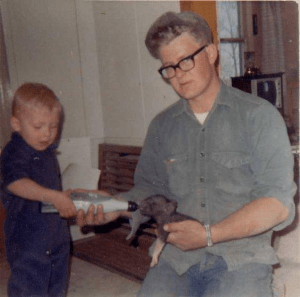
Dad’s casket was lowered into the grave by my brother, me, and the other pall bearers. It didn’t seem real. Dad could have overcome anything. He idolized John Wayne, and at times sounded like him when speaking. He could have single handedly accomplish what several men on other farms only attempted. Dad had dreamed to leave the farm for a better life himself, attending a local community college until the expenses of his first born – me – forced him to return to the stable life and income of the family farm. Dad’s fate was sealed when his father became severely ill from emphysema and could not farm; Dad took over the family business. But he rarely revealed the disappointment and bitterness that sometimes showed only in the hardest of times. Instead, he became a force of nature, leaving a vacuum around all that knew him when he passed. Dad was indeed a bear, but his own growl was the strength and independence that came from a long line of ancestors, farmers, that worked the land before him, often as pioneers just ahead of the creep of civilization as it progressed west with our expanding country. But Mom’s unshakable words, “Kin, yer dad died”, verified the impossible.
Following the burial, a long line of those in the community streamed by the family to pay their respects. After being away for many years, I did not remember many, but that did not stop them.
Many in turn would say, “Do you remember me?”, followed by a long pause to respond. Then they would let you of the hook with, “Why, I am. . .”.
To get through, you nod, smile, and reply, “Of course I remember. . .”. At the end of the day the convenience store’s best Coors will be your reward for enduring the heat and close scrutiny.
The last to pay his respects was Reverend Bob. With a smile, and quick handshake, and “Hang in there!” Reverend Bob mounted his motorcycle and rode away, leaving the family to wonder what to do next.
My parent’s house was quiet. Too quiet. Not even the police scanner squawked its alerts. Sitting together around the kitchen table, we were somber, but somehow we felt at peace. It wasn’t that a long, painful, and dark illness was finally over, not just for my Dad, but now for all of us. It was something else. We each began to talk about times like he was still with us. Somehow we felt him in that house and in the small kitchen. Smiles turned to laughter and jokes as we remembered the good times and how Dad was at the center of it. He was always at the center of things. And we could feel that he was, even now.

Later, I stepped outside of the small farm house to catch my breath. The day was almost over and the sun was beginning to set. The nearby fields and their crops of wheat were maturing with foot tall wheat that was dark green in the golden wash of the sun. I stood at the edge of a large wheat field, taking in a tangerine sunset and looking to the southwest at the silhouette of the cemetery where Dad now resided. The dull purr of a far off tractor tilling a field for the next season of wheat could be heard in the distance. A gentle murmur of a slight breeze could be heard. It touched the stands of wheat and nudged them to undulate in the slight ripple of a green sea into the distance. But I wasn’t alone. I felt something nearby. Something familiar. It made me want to find a John Wayne movie and watch it.
~ Mason
 North of Nowhere - Bridging Different Worlds
Leave a comment